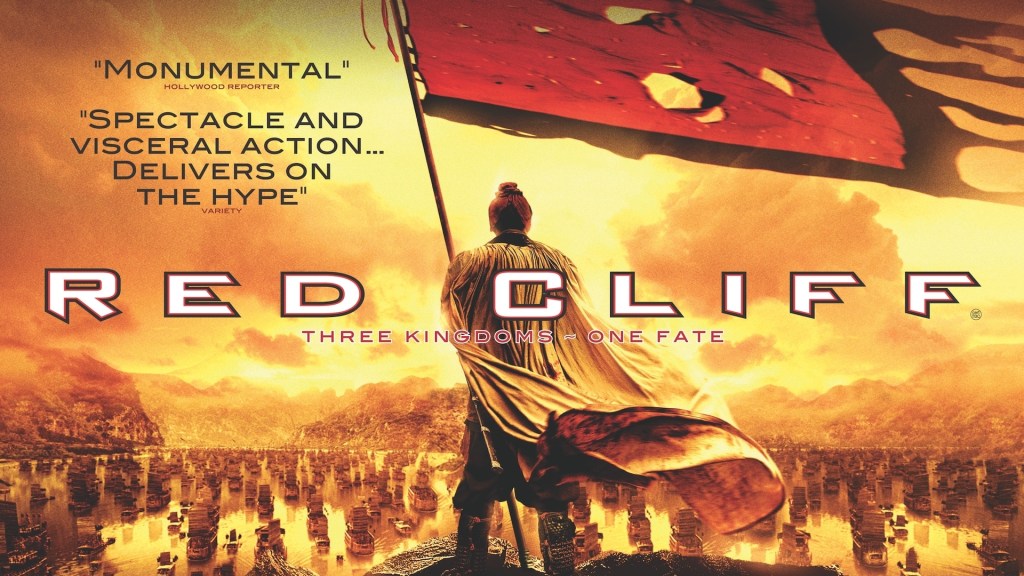
Hong Kong auteur John Woo presents his most elaborate of spectacles with the epic Red Cliff. Full of violence, political intrigue, and a cast of historical characters that are as equally complex-yet-shallow as the Greek pantheon, Red Cliff most importantly elevates Woo’s stylistic filmmaking to, perhaps finally, emulate that of Kurosawa’s Ran and even Jackson’s Lord Of The Rings trilogy.
| Title: Red Cliff (2008) Director: John Woo Writer: John Woo // Khan Chan // Cheng Kuo Studio: China Film Group Corporation IMDb Plot: A story centered on a battle fought in China’s Three Kingdoms period. Joe Says: Red Cliff elevates John Woo’s stylistic filmmaking. Red Cliff can also be patience-testingly slow at times. |
The tale, like a tasty plate of sweet-and-sour chicken, is both simple and complicated. A corrupt Prime Minister of the Han Dynasty declares war on the two lesser kingdoms in third century China (220-280 CE). The result is the bonding of the Xu and Wu kingdoms. The Xus and the Wus use extraordinary tactics taking full advantage of their seaworthy prowess to defend against, and ultimately defeat, the larger nation. Clearly everyone involved has seen Braveheart.
Or at the very least, The Bad News Bears.
Battles aside, the intense, internal statecraft and disparate character plot points overburden the production with heavy storylines that are usually better suited for a miniseries as opposed to one, long film (albeit split into two parts). Having a working knowledge of Chinese history, including this chronicled battle, would certainly enhance the film’s storytelling, but such could be as foreign to Western audiences as the story of Wyatt Earp, Doc Holliday, and the shootout at the OK Corral would be to the East. Huckleberries not included.
Historical epics tend to focus on the overall story with the singular lead – either antagonist or protagonist – weathering the human journey aspect. However, Red Cliff‘s headliner of Woo mainstay Tony Leung, along with Takeshi Kaneshiro and Shidô Nakamura, fill out a talented cast, giving life to the mythological names they are portraying.
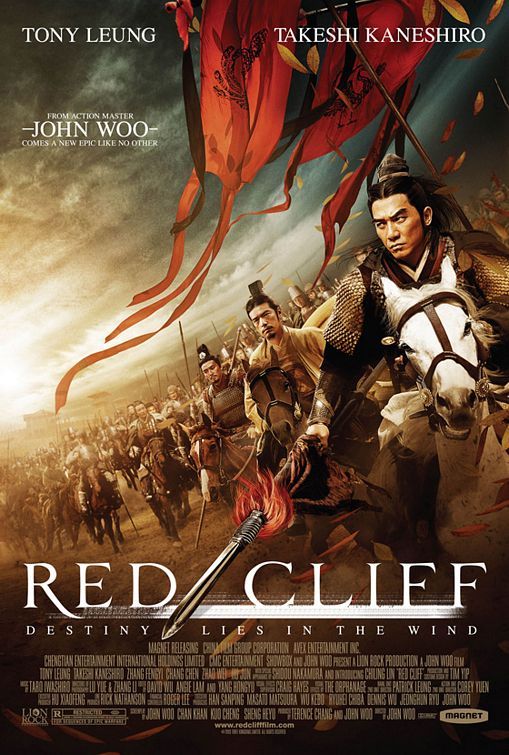
When not dealing with Cao Cao’s (Fengyi Zhang) campaign, or the naval commanders’ battle rhetoric, or the sweat-inducing production of arrows, Woo gives his all on the true star of the film: the action.
The various battle scenes showcased throughout the film are cinematic masterpieces. Woo has successfully distanced himself from his Hollywood bombs such as Paycheck and Windtalkers and learned from those missteps. Here, the CGI is incorporated with models, practical sets, and the use of hundreds of extras elevating what could easily be video game cutscenes into achievements worthy of those memorable battles from the aforementioned LOTR and Braveheart movies. Woo balances the sword-edge thin difference between the beauty of honorable war and violence for havoc’s sake like a samurai master. With Red Cliff he shows mastery in his craft while maintaining a trademarked style from his shoot ’em-laden beginnings like The Killer and Hard Boiled, such as his frequently-used Mexican standoff image. But for Red Cliff, Tony Leung uses a sword.
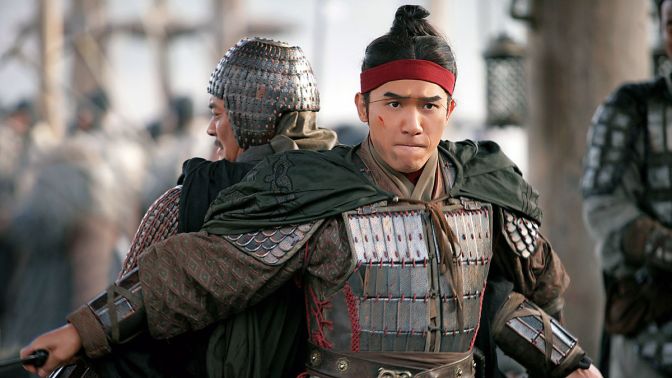
Similar to cooking basmati rice or Southern-style grits, Red Cliff can be patience-testingly slow at times. Ironically, there are too many action scenes that are overly fantastical stretching the realm of the believable. Woo manages these with a wink, honoring the mythological fiction of story to supersede the events of reality.
After all, for a filmmaker that made taking one’s face off believably interesting, throwing in some Shogun Theater Hong Kong action is a welcome spice for this entertaining five-course meal.





 Read @ Joe’s
Leave a comment