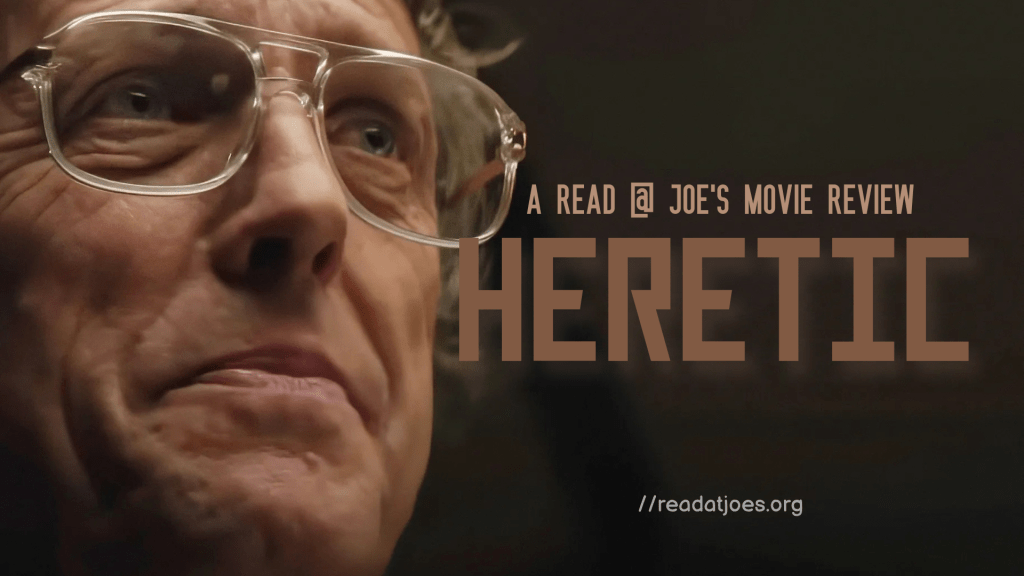
| Title: Heretic (2024) Director: Scott Beck // Bryan Woods Writer: Scott Beck // Bryan Woods Studio: A24 IMDb Plot: Two young religious women are drawn into a game of cat-and-mouse in the house of a strange man. Joe Says: Heretic grounds the concepts of belief and disbelief into a deadly situation of life or death. The movie is creepy, disturbing, and a devilish good time. |
In a world where everyone has opinions, Heretic – the new horror-thriller from A24 starring Hugh Grant in his used-car salesman slimiest – runs through the gamut of living-room conversations from ranking fast food chains to board games’ history, the songs of Oasis versus those from the Hollies, and, oh yes, ponderings on religion. Written and directed by Scott Beck and Bryan Woods (creators of A Quiet Place), Heretic grounds the concepts of belief and disbelief into a deadly situation of life or death. The movie is creepy, disturbing, and a devilish good time.
The always-charming Grant plays Mr Reed, a kindly recluse who is faithlessly searching for answers in the heavens. Two Mormon missionaries, the adorably teenaged Sister Barnes (Sophie Thatcher) and Sister Paxton (Chloe East), come to Reed preaching those LDS tenets of biblical golden tablets and virtuous Jell-O. Reed is, at first, full of smiles and blueberry pie promises. Yet instead of falling into a Road to Damascus conversion, Reed twists the religious convo with a forked tongue fervor. He reveals deep conflicts between faith and doubt, and pounds away at the struggle to believe with the conviction of a Revivalist. Eventually, his sermons fall into hazardous territories as Barnes and Paxton find themselves mortally trapped in his torturous house.
Heretic expertly slathers that Silence of the Lambs terror with an artificially sweet Sunday School primer. Reed’s comfort gives way to caution. Barnes and Paxton’s “go-get-‘em-girl” spunk falls into fight-or-flight panic. The transition between is elegant and effortless.
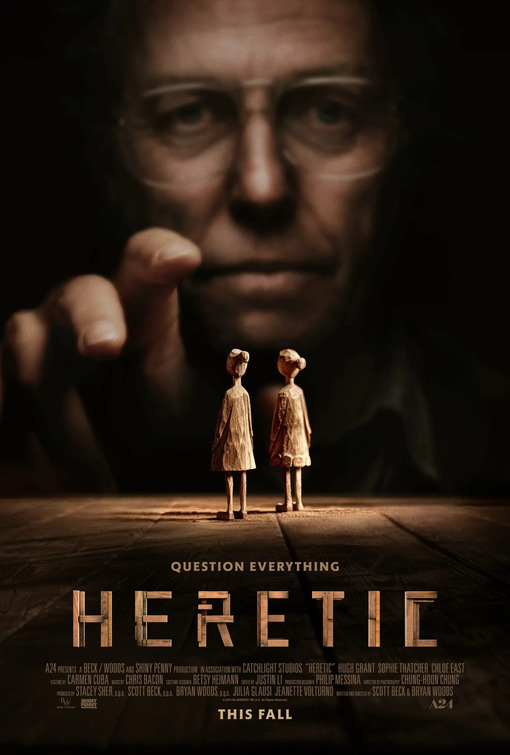
Beck and Woods go deep into theology, at least in accordance with the Gospel of Hollywood, as Reed’s monologues become barbed with pop-culture deception and Kabbalah voodoo. His smiles become threats as ominous as storm clouds. Chung-hoon Chung’s haunting cinematography plays into the claustrophobia of it all, too. Shadows become deeper and Reed’s already-suffocating wallpaper transforms into a prison.
Yet for all of the discussion on theology – the breakdown of Judaism-Christianity-Islam, the Babylonian and Egyptian influences, the LDS photocopy of a photocopy doctrine – nothing new is presented. Yes, the packing is shiny but Reed’s diatribe is considerably one-sided. Paxton tries to call him on that, but she, too, is blinded by her side of the argument. At no time do Beck and Woods account for faith. Not mere, blind belief, mind you, but conviction-in-my-bones faith is never given its due course. Instead, and as predictably expected, the narrative gives way to the classic horror tropes, which arrive in style.

Heretic’s horrific style amps the game for its players. Thatcher and East are both wonderfully innocent and play into the fear. Each of them have secrets, which become cleverly unwrapped as the story moves on. East’s Paxton is all bunny-rabbit bright – until she begins to sweat. Thatcher’s Barnes stands stronger, but she too sways. Grant, perfectly cast, tears into his role like a master thespian schooling a summer repertoire. And it is glorious.
Heretic is altogether clever with its laid out dialogue and convincing action. It only becomes momentarily convenient in order to satisfy the genre’s hunger. And homemade blueberry pie is enough to make anyone a believer.

Sanctify yourself and read the full Heretic movie review also on Cinefied



 Read @ Joe’s
Leave a comment